
Feature Engineering: The Hidden Work That Makes Models Actually Work

In the world of machine learning, models often get the spotlight. From deep neural networks to gradient boosting machines, we celebrate architectures, hyperparameters, and benchmarks. But behind every high-performing model lies something far less glamorous—and far more important: feature engineering.
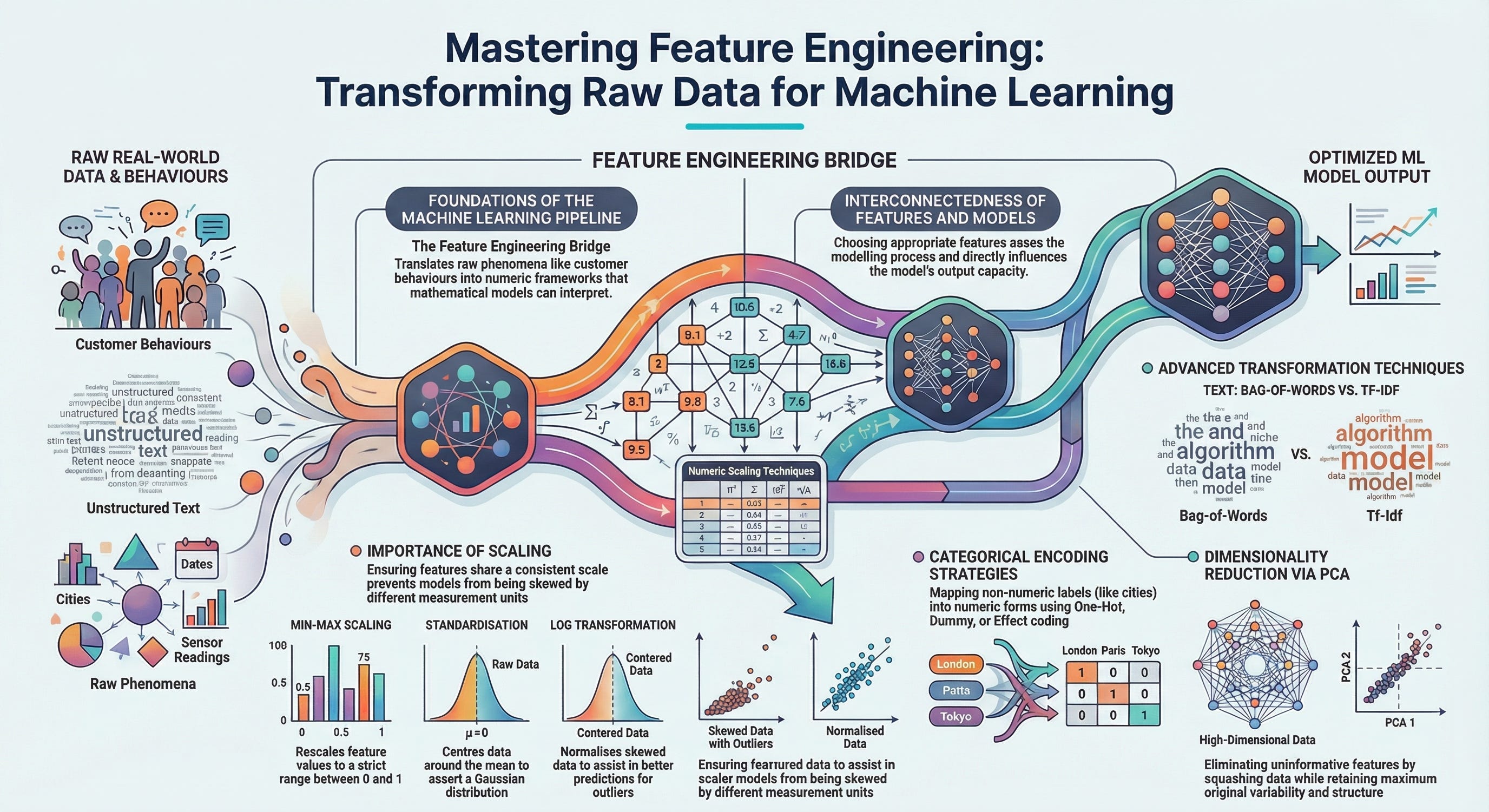
Feature engineering is the process of transforming raw data into meaningful inputs that help models learn patterns effectively. It is not just a step in the pipeline; it is the backbone of any successful machine learning system.
Why Feature Engineering Matters More Than You Think
A common misconception is that better models automatically lead to better results. In reality, even the most advanced algorithms struggle when fed poor-quality features.
Consider this:
A simple linear model with well-crafted features can outperform a complex deep learning model with raw, unprocessed data.
Most real-world datasets are messy, noisy, and incomplete.
Feature engineering bridges the gap between raw data and model understanding.
What Exactly Is a Feature?
A feature is any measurable property or characteristic used as input to a model.
Examples:
In a housing dataset: price, location, number of bedrooms
In time series: lag values, rolling averages, seasonality indicators
In text data: word counts, embeddings, sentiment scores
The key idea is simple: features are how your model “sees” the world.
Types of Feature Engineering
1. Data Cleaning
Before creating new features, you must fix what’s broken.
Handling missing values
Removing duplicates
Fixing inconsistent formats
Garbage in, garbage out—this principle defines the importance of this step.
2. Feature Transformation
Transforming existing features into more useful forms.
Log transformations for skewed data
Scaling (MinMax, Standardization)
Encoding categorical variables (One-hot, Label encoding)
These transformations help models converge faster and learn better patterns.
3. Feature Creation
This is where creativity plays a major role.
Combining features (e.g., price per square foot)
Extracting date-time components (day, month, weekday)
Creating interaction features
This step often separates average models from exceptional ones.
4. Feature Selection
Not all features are useful.
Remove redundant or highly correlated features
Use techniques like correlation analysis, mutual information, or model-based importance
Simpler models with fewer but meaningful features often generalize better.
5. Domain Knowledge
This is the secret weapon of top practitioners.
Understanding the problem domain allows you to:
Create meaningful features
Avoid misleading patterns
Capture real-world relationships
No algorithm can replace domain expertise.
Real-World Example
Imagine predicting customer churn.
Raw data might include:
Signup date
Last login
Number of transactions
Engineered features could be:
Days since last activity
Average transactions per month
Customer lifetime value
These engineered features provide far more predictive power than the raw inputs.
Feature Engineering in the Era of Deep Learning
There is a belief that deep learning removes the need for feature engineering. This is only partially true.
While neural networks can learn representations automatically:
Structured/tabular data still heavily relies on feature engineering
Even in deep learning, preprocessing and transformations matter
In practice, feature engineering and model design go hand in hand.
Common Mistakes to Avoid
Over-engineering too many features
Leakage (using future information in training)
Ignoring data distribution differences
Not validating feature impact
Feature engineering is powerful—but only when done carefully.
A Simple Framework to Follow
Understand the data deeply
Clean and preprocess
Create meaningful features
Evaluate their impact
Iterate continuously
Feature engineering is not a one-time step—it is an iterative process.
Advanced Feature Engineering Techniques - Kaggle Competitions
If you’re aiming to push leaderboard (LB) performance—especially in competitions—feature engineering becomes even more systematic. The goal is simple: create features, validate them locally, keep what improves CV (cross-validation), and discard the rest.
If you generate many features, use techniques like:
Forward Feature Selection
Recursive Feature Elimination (RFE)
Model-based importance (e.g., LightGBM)
Permutation Importance
Train and Test Consistency
When performing transformations like label encoding, always combine train and test to avoid inconsistencies:
df = pd.concat([train[col], test[col]], axis=0)
# FEATURE ENGINEERING
train[col] = df[:len(train)]
test[col] = df[len(train):]
You can also process them separately when needed:
df = train
# FEATURE ENGINEERING

df = test
# FEATURE ENGINEERING
Handling Missing Values (NaN Strategy)
LightGBM treats NaNs specially at each split, which can sometimes lead to overfitting.
A simple alternative:
df[col].fillna(-999, inplace=True)
This forces NaNs to behave like regular values. Always experiment both ways and validate.
Label Encoding + Memory Optimization
Convert categorical variables into integers efficiently:
df[col], _ = df[col].factorize()

if df[col].max() < 128:
    df[col] = df[col].astype('int8')
elif df[col].max() < 32768:
    df[col] = df[col].astype('int16')
else:
    df[col] = df[col].astype('int32')
Memory optimization tip:
for col in df.columns:
    if df[col].dtype == 'float64':
        df[col] = df[col].astype('float32')
    if df[col].dtype == 'int64':
        df[col] = df[col].astype('int32')
Categorical Handling
After encoding, you can either:
Treat as numeric
Or explicitly mark as categorical
df[col] = df[col].astype('category')
Try both approaches and validate.
Feature Splitting
Break a single feature into multiple informative parts.
Examples:
“Mac OS X 10_9_5” → OS + Version
1230.45 → Dollars + Cents
Models cannot automatically extract these structures—you must expose them.
Feature Interactions (Combining Features)
Create interactions to reveal hidden relationships:
df['uid'] = df['card1'].astype(str) + '_' + df['card2'].astype(str)
Or numeric interactions:
df['x1_x2'] = df['x1'] * df['x2']
These often unlock strong predictive signals.
Frequency Encoding
Helps the model understand rarity:
temp = df['card1'].value_counts().to_dict()
df['card1_counts'] = df['card1'].map(temp)
Rare vs frequent values can be highly predictive.
Aggregations / Group Statistics
Provide context within groups:
temp = df.groupby('card1')['TransactionAmt'].agg(['mean']) \
    .rename({'mean': 'TransactionAmt_card1_mean'}, axis=1)

df = pd.merge(df, temp, on='card1', how='left')
This lets the model compare a value against its group behavior.
Normalization / Standardization
Standard scaling:
df[col] = (df[col] - df[col].mean()) / df[col].std()
Or relative normalization:
df['D3_remove_time'] = df['D3'] - df['D3_week_mean']
This removes unwanted trends (like time drift).
Outliers & Smoothing
Outliers can hurt—or help—depending on the task.
One practical approach:
Use frequency encoding
Replace rare values (<0.1%) with a constant like -9999
Be careful: in anomaly detection tasks, removing outliers may remove the signal itself.
That’s a Wrap!:
At an advanced level, feature engineering becomes less about intuition and more about experimentation, validation, and iteration.
The best practitioners don’t just build features—they build systems to test features quickly and reliably.
Because in the end, the difference between a good model and a great one often isn’t the algorithm.
It’s the features.
In this article, I have just gone through the topic in a very simple manner. Hoping that you have liked the article.
Reference:
IEEE-CIS Fraud Detection | Kaggle
Feel free to click the ❤️ on this post so more people can discover it on Substack 😍. Tell me what you think in the comments!
Cheers,
Samith Chimminiyan
Is feature engineering still important or even needed for llm in agentic ai workflow? How do you think?